Plugins.
Custom WordPress plugins give you functionality built around the way your business actually works.
We develop lightweight, maintainable plugins for specific workflows, automation and platform requirements, without loading WordPress with functionality you do not need.
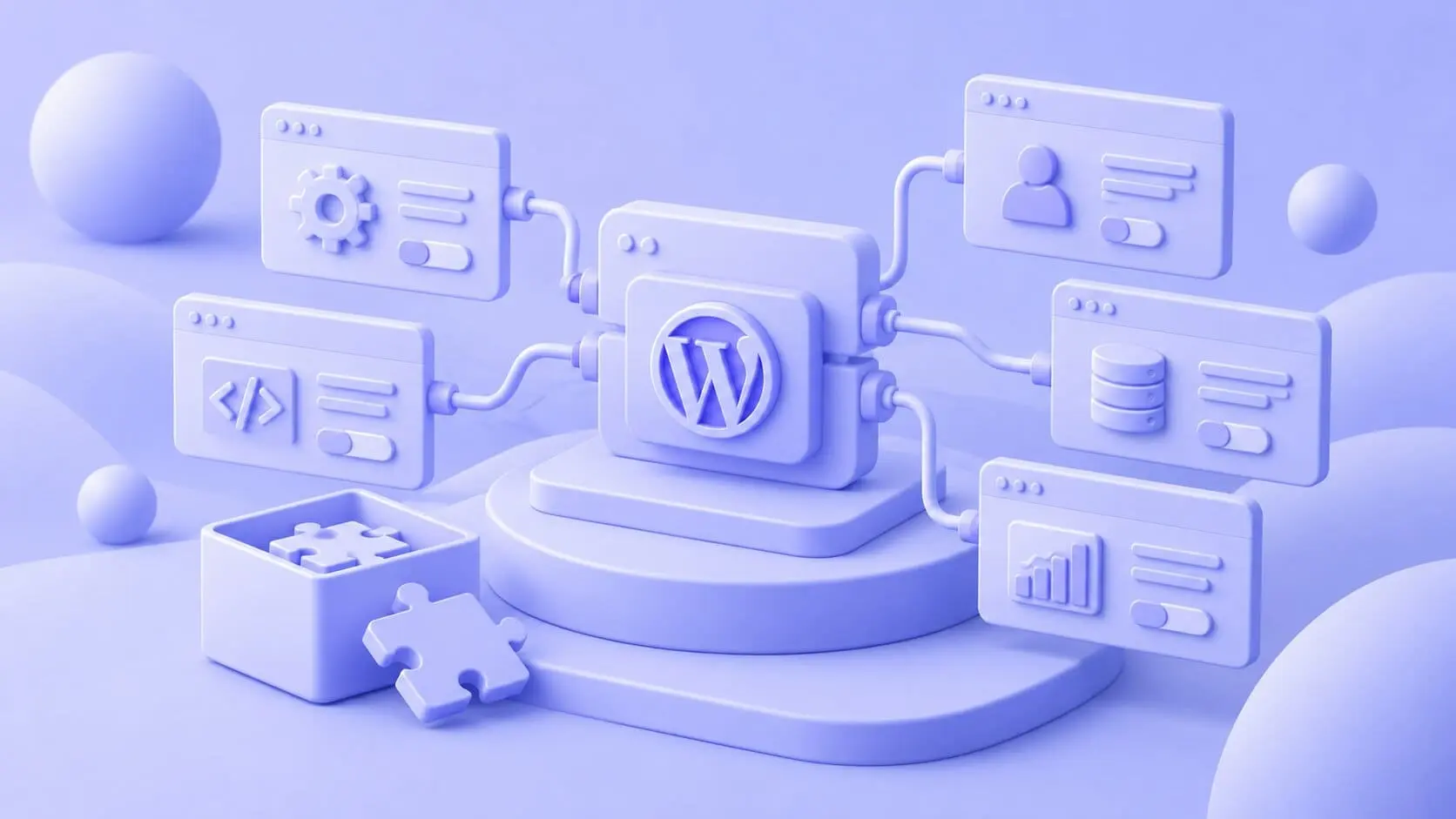
CUSTOM WORDPRESS PLUGINS
Standard plugins are useful when the requirement is standard too. Once functionality becomes more specific, adapting several third-party plugins around the problem can create unnecessary dependencies and make the platform harder to maintain. We develop custom WordPress plugins around defined requirements, giving us control over the functionality, codebase and how the plugin interacts with the rest of the platform.
That can mean automating an internal process, adding functionality unique to the business or extending an existing WordPress setup with logic that does not exist off the shelf. Plugins are developed with performance, security and future maintenance in mind, so the functionality can evolve without becoming a fragile part of the wider WordPress solution.
Functionality shaped
around your needs.
Less repetitive manual work.
Only the functionality you need.
Built for the wider
WordPress setup.
Structured for future
development.
OUR PROCESS
Custom functionality starts with a clear requirement.
Before development begins, we define what the plugin needs to do, how it fits into WordPress and which users, systems or processes depend on it.
WHEN CUSTOM MAKES SENSE
When standard functionality stops fitting the requirement.
Custom plugin development makes sense when the functionality is specific enough that forcing an existing plugin into the job creates more complexity than it solves.
Automate a business process
Manual follow-ups, scheduled tasks and repetitive administrative workflows can often be handled directly inside WordPress.
We can build the rules, triggers and admin controls around the way the process actually works.
Build functionality unique to your platform
Some platforms need features that simply do not have a suitable off-the-shelf equivalent.
A custom plugin lets us build that functionality around the users, data and workflows already inside WordPress.
Connect functionality across systems
A plugin can also act as the WordPress layer behind a wider integration, handling data, authentication or business logic inside the platform.
For projects where the main challenge is communication between systems, our API & Integrations expertise goes deeper into that architecture.
Custom plugins work inside a wider WordPress setup.
A plugin can affect themes, integrations, performance, maintenance and infrastructure. These expertise areas cover the technical layers around custom functionality.
Connect plugin functionality to external systems.
Custom plugins often provide the WordPress-side logic behind CRM, ERP, PIM, payment or other system integrations.
We build APIs and integrations around reliable data flows, authentication and the requirements of the platforms involved.
Keep custom functionality fast and controlled.
Every additional feature affects the wider platform.
We work across performance, access control, monitoring and security so custom functionality does not create unnecessary load or exposure.
Keep custom code compatible over time.
WordPress, PHP and connected dependencies continue to change after a plugin launches.
Ongoing maintenance helps keep custom functionality compatible, stable and ready for future development.
Keep functionality separate from presentation.
Custom themes handle the interface and editing experience, while plugins are better suited to functionality that should exist independently of the theme.
We build both around a controlled WordPress architecture so each layer has a clear role.
Decide which functionality should move forward.
Older WordPress platforms can contain years of plugins, custom code and dependencies.
During a migration or upgrade, we review what should remain, what needs rebuilding and where custom functionality needs a cleaner implementation.
Give demanding functionality the infrastructure it needs.
Automation, large datasets and complex application logic can place additional demands on WordPress.
We work with scalable hosting and infrastructure when the platform needs more capacity, resilience or operational control
Custom WordPress functionality in practice.

CUSTOM WORDPRESS PLUGINS
Need functionality WordPress doesn’t have yet? Talk to us about your project.
Contact usFAQ
Questions about custom WordPress plugins.
Custom functionality needs to work reliably with the rest of WordPress and remain maintainable as the platform changes. These are some of the questions we usually cover.
A custom plugin makes sense when the functionality is specific to your business, process or platform and existing plugins cannot meet the requirement cleanly.
It can also be a better option when achieving the result with several third-party plugins would create unnecessary dependencies, complexity or maintenance work.
Plugins can support a wide range of functionality, including automation, workflows, user management, scheduled processes, custom admin tools, data handling and integrations.
The functionality is built around the requirement rather than limited by an existing plugin’s feature set. Our current plugin work includes business automation and integration-specific development.
Yes. A custom plugin can be added to an existing WordPress platform if the current architecture can support the functionality.
We first review the existing setup, dependencies and relevant data before deciding how the plugin should fit into it.
Yes. Plugins can handle WordPress-side functionality for connections with systems such as ERP, CRM, PIM and payment platforms.
If communication between systems is the main requirement, the project may fall more naturally under our API & Integrations expertise.
We keep the plugin focused on its defined responsibility and account for performance, security, compatibility and future development during implementation.
Testing and ongoing maintenance are important as WordPress, PHP and other dependencies change over time.


